|
Michael McFadyen's Scuba Diving - Whale Watching Rockfall
The section of Sydney coastline from Botany Bay to Cronulla is a relatively undived section of the coast. There are a number of reasons for this, the main ones being that the sewage outlet at Potter Point (just south of Cape Baily Lighthouse) used to pour basically untreated effluent into the water and the fact for most of the last 40 years there has been no permanent diver charter boat working out of Botany Bay.
Since April 2001 when the Kurnell Sewage Treatment plant was upgraded to tertiary status, the water has been much cleaner along the Cronulla beaches and the coast north of the outlet. Over the past 15 years we have done a number of exploratory dives in this area, especially since the treatment works was upgraded. We have discovered some really good dives, but none as good as this dive which was a byproduct of a site discovered by John Beddie, a former member of my dive Club.
To find this spot, head out of Botany Bay and head south along the coast. About 1.5 kilometres from The Leap dive site (this is the eastern most end of the southern side of the entrance to the bay) you will see a headland. This is Cape Solander. On the top of the reef you will see a structure, the Whale Watching Platform. This was built to provide protection for the volunteers who each year watch the sea off here during the humpback whale migration period (mostly June and July each year) as well as the many thousands who come to look for whales.
 |  |
| Whale Watching Platform | The corner showing the shear wall |
The GPS Reading for this location is 34° 01.1232' S 151° 13.9702' E using WGS84 as datum - read the GPS Page from left if you do not know what this means. Be a bit south of the platform as shown in the photograph at right. Run in towards the rockfall which is very obvious and drop anchor when the depth comes up from 22 metres to 18 metres. You can also anchor up to 100 metres to the north and still have a great dive. I have that location as a separate article, Whale Watching Platform.
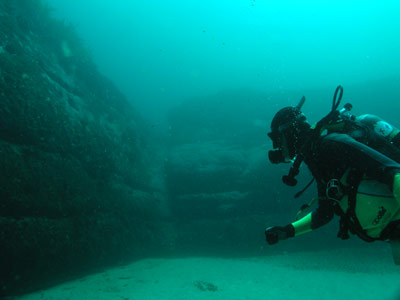
Once you descend and get to the bottom you should find yourself on a rocky bottom that may have some sand patches. If you are a bit further to the south then it may be a bottom with lots of large boulders. The depth should be about 19 to 20 metres. If you are deeper then you are east of the deeper wall. With good visibility you should see the wall to the west. This will be quite shear, dropping from 12 or 13 metres. There are sponges and sea squirts on the wall as well as a few small gorgonias.
When you reach the wall, head north to start the dive. Within 10 metres there is a swim-though located off the wall and then another 10 metres along you should come across the first cave. This is quite large, although it is a bit low. You can go inside but there is probably no need to as a good torch will let you see everything inside. There is normally at least one eastern blue devilfish living in this cave and you may also see some Port Jackson sharks on the bottom.
 |  |
| The entrance to one cave is under this overhang | One section of the wall |
Head north again and you will see another larger cave not that far along. This one you can easily swim inside and through, exiting out a bit to the south. You can get some nice photos from inside. See the photograph above. After this, head north once more. You will come to a sort of corner. Turn right and head east over some small boulders and then onto the flat rock.
There are lots of round or figure 8 shaped holes in the rock in this area and further south. Some look like large bathtubs. A little to the west there is a small wall and you can drop over this to 21 or 22 metres. Follow this south and it heads back gradually towards the wall.
Eventually you will come to the area near your anchor and then the wall. Follow it to the south. There is a sort of crack between the main part of the reef and a large boulder. Go to the left of the boulder and then you will turn west. Go a little shallower here and there are a few large boulders and on the main reef a small overhang. I have seen blue devilfish in this area and in March 2026 I even saw a juvenile Moorish idol.
 | 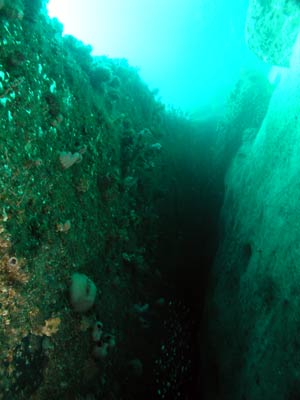 |
| Geoff Sanders outside one of the caves | A crack in one section of the wall |
You can go a bit further if you are using nitrox, otherwise you will probably need to turn now. Anyway, on the way back, go via the crack and go back to the main wall and then the anchor. If you have air and bottom time, go out under the boat and have another look at the holes and small wall.
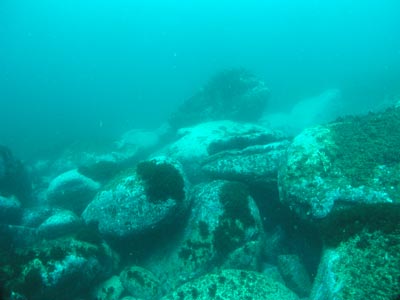 |  |
| Some of the large boulders at this site | A sea dragon missing its entire tail! |
As well as the fish mentioned, you may see many species of leatherjackets and lots of cuttlefish. I also saw quite a few nudibranchs. We have seen large schools of yellowtail and one-spot pullers.
As this site is located fairly close to the entrance to Botany Bay, you may get affected by outgoing tides if the water inside the bay is particularly dirty, although I have dived here at low tide after 50 mm of rain (when the bay was pretty bad) and had 15 metres visibility. I have averaged between 12 and 15 metres on my dives at the two sites here.
This is a fantastic dive site, one of the most interesting spots I have dived in Sydney. It is worth diving many times and I hope to explore it more with my scooter.
MORE PHOTOS
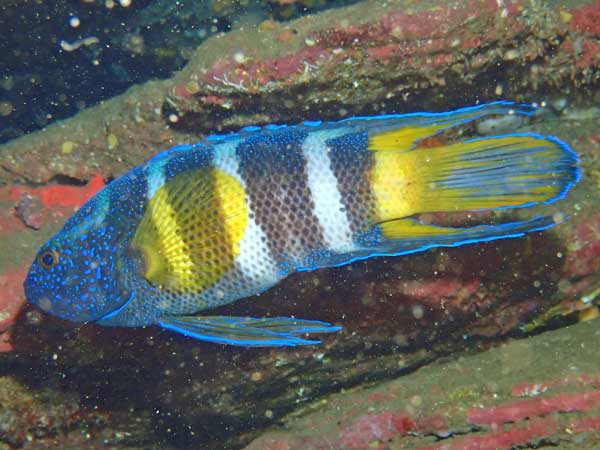 | 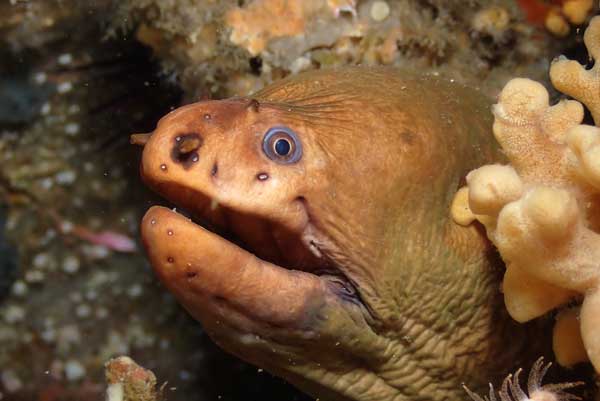 |
| A blue devilfish in a cave | A large moray eel |
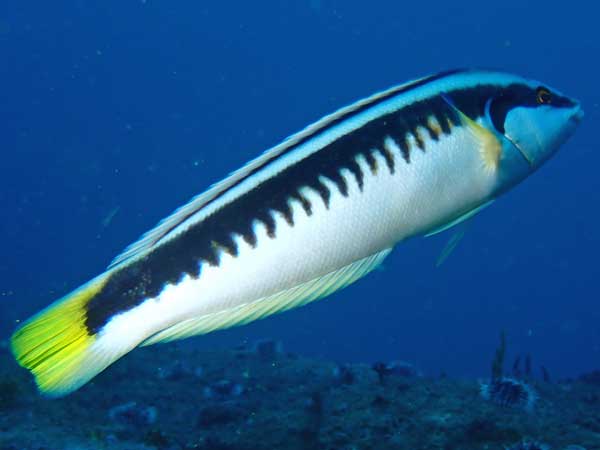 |  |
| A comb wrasse | A pygmy pipehorse |
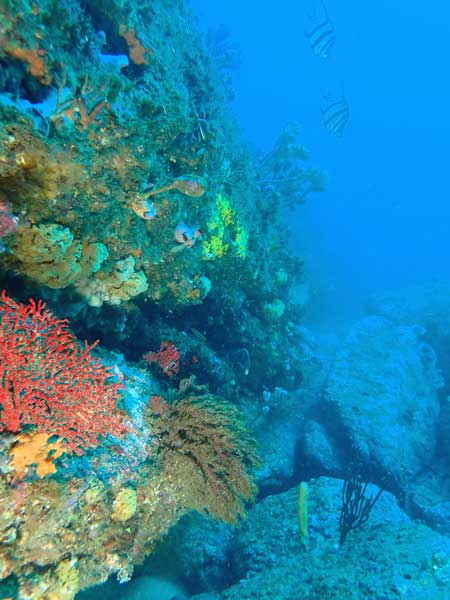 | 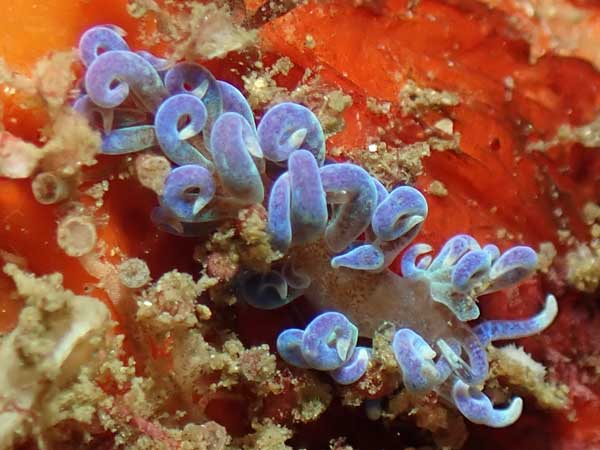 |
| A particularly colourful section of wall | A nudibranch |
| 



 v6.00.307 © 2003-2005


